Never lose sight of the Circle
Talking about the Great Spirit, the Creator or better of the Sacred Mystery is quite complicated and it is complex to describe the concept appropriately in a few simple sentences, and I want to strongly avoid misleading anyone. For this reason I consider it appropriate to begin by providing clarifications. First we must return to the Circle ... never lose sight of the Circle! In Indian societies throughout North America, all possessions were shared. There were no "poor" or better, everyone was "equal" in wealth. This is because "Respect" towards a person was not measured by ownership, but on his behavior towards and for the group. Even the Leader was equal to all the other members of the society. His actions and his wisdom were the elements that led him to become Head of the Community. This egalitarian attitude still derives from the concept of the "Sacred Circle". For any substantial or important conversation, everyone was sitting together in a circle when they wanted to talk. In a circle you can see everyone's face, so you can understand someone by looking at it. In a circle there is no competition, because it has no end nor beginning.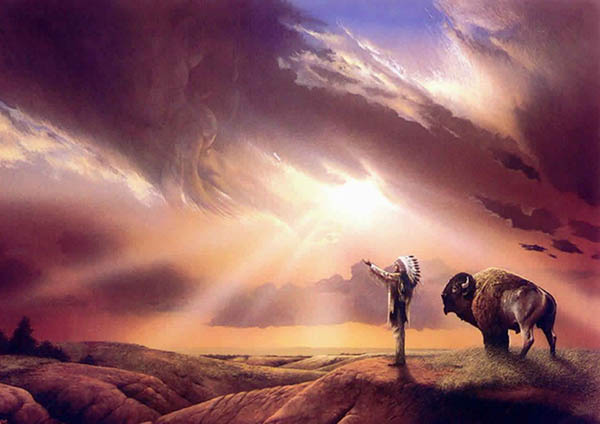 I wanted to emphasize these words; equal (to indicate equality), respect and Sacred Circle because they are "words like symbols" common to the vast quantity of Indian nations. And there are other symbols!
I say this because, among the different nations, there is not a unitary "earthly" culture to which the term "native American culture" refers. Because all nations are rich in traditions that are different from each other.
Moreover, the approach versus "the Creator" for example, differs also in the concept that, for some, it is a supreme and omnipresent divine entity; for others an idea of balance, harmony and peace; for others still a concept of a living universe and, for others, a kind of fusion of all these concepts.
But, according to my humble opinion, the concepts towards the sacred are only an "earthly" approach to identify the sublime, the grandiose, ... to identify God.
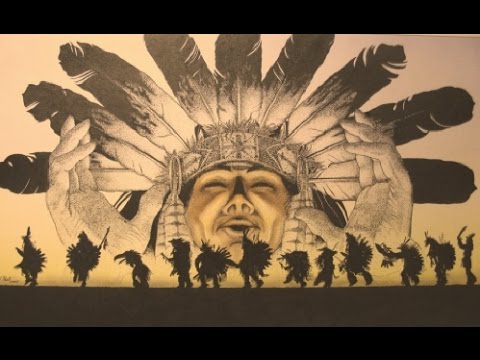
However, among the various Indian nations there exists a "Spiritual Culture" which unites them in intimate terms through common symbols, through education, through respect and through the Sacred Circle! It is precisely this spirituality that is part of their intimate that sees them reunite every year in PowWows! The vast majority of American Indians share other symbols; "silence"; "prayer"; "the Dance (which almost always is prayer)" and "Mother Earth". Always in the Sacred Circle.
In their conviction, all they know is that the Creator, this Unknown Force is in the Circle!
WAKAN TANKA
Now lets view the Creator portrayed as the "Great Spirit". Why do I portrayed, because it is an English and American dominant culture term. In reality it does not correspond to a single entity in Native American cultures. Some cultures that have had their beliefs translated this way are the Lakota and related languages as well as the Algonquin speaking populations. The Lakota idea of Wakȟáŋ Tȟáŋka that is sometimes translated as the Great Spirit has a more complex meaning. Wakhan means divine or holy. Thanka means a collection of unknown entities. It is not really a singular deity as the English translation of the Great Spirit would imply. Among the many people who talk Algonquin like the Anishinaabe culture is a concept called Gitche Manitou. This was used by the missionaries to translate as "god" or "holy spirit". It's more complex than that. Manitou is more like saying "the way" or "the path", the interconnection and balance of nature and life. Gitche means the collection of all these forces and connections. It is the term to speak of the non-hierarchical existence of all these forces, spirits and interconnections. Today it is used by many people as a synonym for an all-encompassing divinity. Therefore, the concept of the Great Spirit varies from nation to nation referring to the Supreme Being with a variety of different names such as "Father", "Elder" or "Grandfather" and in these nations the Great Spirit is perceived either as a man, or an animal, with human thoughts and words. Some of their beliefs about the Great Spirit stem from patriarchal and matriarchal traditions. For the Lakota, the Great Spirit is also an amalgamation of a god of heaven, the dominant Father and Mother Earth. The Great Spirit is seen as both a male and a separate female being, but part of a single divine entity. Moreover, it is against their tradition to try to find out how this Entity is. Is far from them this thought. They do not know if the Creator is a man or a woman but they believe that the Creator or this Nameless Force is in the Sacred Circle.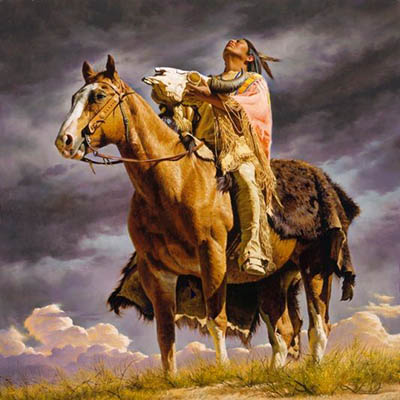 In ancient times, the word Wakan Tanka was not used in normal conversation, because they considered it too sacred and worthy of respect.
Many Native Americans, during normal conversation, even avoid mentioning a man's name, especially when he is present. Leaving things unspoken is a very profound way of thinking. To express oneself completely is not in their tradition. The unspoken word can be a case of understanding on both sides. At most, they make a suggestion in some way, so that only those for whom words are intended will understand their meaning.
Now the Great Spirit (for example: Wakan Tanka and Gitchi Manitou) is a beautiful example of a non-theistic belief in an active, personal, non-anthropomorphic divinity that intertwines with the plot of the Universe himself on a large scale and yet This Entity is personally engaged with the network of living beings and the world on a terrestrial scale.
But let us remember that Great Spirit does not express the true concept of the Creator for Native Americans
The term that instead comes closest to Wakan Tanka is that identified by Russell Means who calls it "Sacred Mystery" which is interpreted as the power or sacredness that resides in everything. The "Great Mystery" is the Eternal that surrounds us and embraces us, the supreme conception that brings with it the measure most full of joy and satisfaction possible in this life.
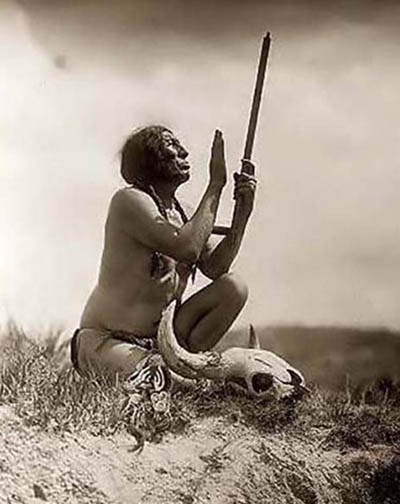
ADORATION OF THE SACRED MYSTERY.
The adoration of the "Great Mystery" is silent, solitary, free from all self-seeking. It is in silence, because every speech is necessarily weak and imperfect. Because the souls of the ancestors rise to Him in adoration without speaking. It is solitary, because they believe that He is closer to us in solitude. It is personal because the relationship is only between man and his Creator. No one could in any way interfere with the religious experience of another. They believe that all men and women were created as sons and daughters of their Creator and conscious of their divinity. Their faith could not be formulated in creed, nor forced by those who were not willing to receive it; therefore there is neither preaching nor persecution, nor even mockers or atheists. For them, nature is their temple, their sanctuary. They belong to nature and are intensely poetic. For them, it would be a sacrilege to build a house for the One who could be meet face-to-face in the mysterious and dark lanes of the primordial forest, or on the sunny bosom of virgin meadows, on dizzying spiers and pinnacles of bare rock, and under a monumental starry sky!