The Clans, a Family of Families
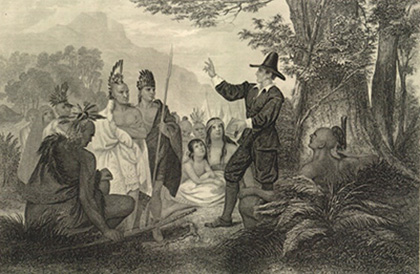 The first Europeans who got to know the Indians of North America and mainly the missionaries, noticed something inexplicable for them. In these communities, relatively populous and apparently, in many respects, so little governed, how could they live together in peace, without law and without forced authority?
There were cities where Indians lived together in thousands with an enviable harmony. This peace and harmony was generally due to the peculiarity of the character and habits of the Indians. In their eyes, they were the most tender and compliant race of humanity. Foreigners, including missionaries, were respected and welcomed with kindness as well as their dogmas. What the missionaries promptly discovered was that their dogmas were respected but they, the Indians, didn't believe them and perhaps didn't even understand them.
Theirs was a kind of courtesy towards the foreigner and his ideas and this behaviour kept all the Indians in mutual agreement even if, this disgusted the missionaries a little. With total self-control the Indians endured the abuse and sarcasm of the first Europeans with surprising patience.
All Indians, and especially those highly populated and stationary nations, had their own code of courtesy, the demands of which were rigid and exact. The Indian nature, inflexible and adamant, was particularly under the control of traditions. Their traditions were the law! Indeed, a Common Law for all!
In this Indian "democracy", more evident in spirit than in form, respect for tradition and the will to yield to it was (and is) always present.
Familiarity
The Europeans noticed that they were always ready to help each other to overcome all the difficulties with a spirit of familiarity - "family" - always present among them. If one family was in difficulty the other families joined together to cope together with the difficulty to overcome it. In return, the recipients of the favor, if they could, gave a party, otherwise, their thanks were enough. And this way of behaving amazed the visitors of the new world! One of the missionaries who left written records was the Jesuit Brébeuf, who knew the Hurons very well, and frequently praised their harmony and social spirit. Between the Iroquois and the Hurons - and undoubtedly among the other nations - there were distinctions marked as to say of nobles and plebs or, rich and poor; to give an example. It is, despite this, while there was food in the village, the richest and the poorest did not suffer hunger.“The poor man did nothing but enter the nearest house and sit by the fire, when, without a word on either side, the food was placed before him by the women”.
Indians communities
 Indians were and still are very sociable in their communities. Besides showing off during their incessant parties and dances, they do so also in the so-called daily life. They often spend time in neighbors' homes, chatting and joking. The joke for them is essential. Exchanging jokes and to tease one another becomes a real verbal tournaments and laughter is always present !!!
In the organization of Indian communities, a very evident characteristic appears continuously. Each nation, to adopt the names with which these communities are usually known, is divided into Clans.
These clans are not locally separated, but are mixed throughout the nation. All members of each clan are intimately united in consanguinity. Therefore, an abomination is held for two persons of the same clan to contract marriage (man-woman). It is considered like incest. Therefore it follows that each family must contain members of at least two clans.
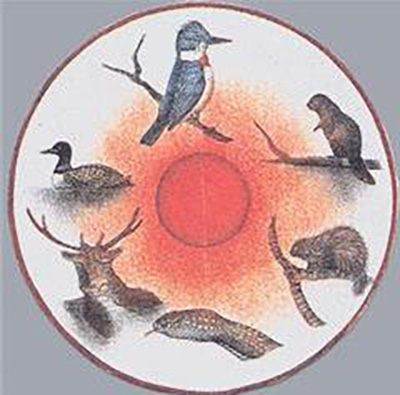
Each clan has its name, like the falcon, wolf or turtle clan; and each has as its emblem the figure of the animal, plant or other object, from which it derives its name. This symbol or emblem, called the totem by the Algonquins, is often tattooed on the body of each member of the clan, or painted over the entrance to their homes.
Taken from a manuscript prepared by J.P. Evans in 1835:
“There are no natural boundaries to their clans; the subjects of different clans being mingled. Those of the same clan are considered as belonging to the same family. In fact this relationship seems to be binding as the ties of consanguinity. An Indian can tell you without hesitating what degree of relationship exists between himself and any other individual of the same clan you may see proper to point out. A man and a woman of the same clan are not allowed to become man and wife. This appearance of ancient custom is yet prevalent to some extent, and the disregard of it is disgusting in the eyes of many ".
Mother
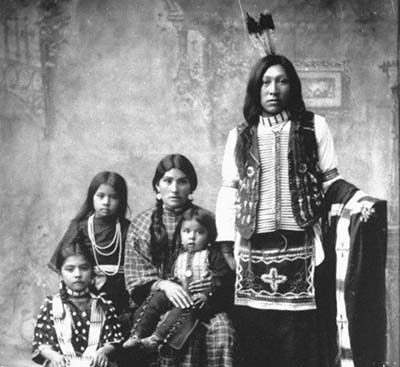 Cherokee societies, for example, are historically matrilineal, which means that the clan comes from the side of the mother. There are no formal written documents of those who belonged to which clan. The traditionalists in the Cherokee communities still retain their clans and their knowledge, but many people of Cherokee descent are not considered members of a Clan if their mother is not Cherokee.
The children belong, in most cases, to the clan, not to the father, but to the mother.
In other words, the descent, not only of the totem (symbol / emblem), but of all degrees, titles and possessions, takes place through the woman.
.
The son of a leader can never be a leader by hereditary title, although he can become such due to his behavior towards and for the good of the community. He cannot inherit anything from his father.
All goods are equally entitled to the brothers of the leader or the children of his sisters, since they are all born of a common mother. The children are the children of the mother !!!
But although the children acquired their birthright only through the mother, individually it was through the father that their kinship extended beyond the mother's clan into that of the father's clan, tying these two clans not only for the parents' marriage, but with the strongest bond of a recognized kinship. With this process the nations' clans were united in a tribal unit or family.
Therefore the family is the basis of the social structure in traditional Native American societies.
.
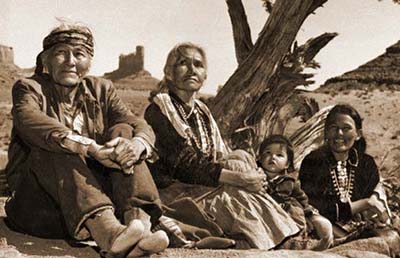 In conclusion, there are no written rules nor complex governments for the Indian nations of north America but rather a defined structure and social norms founded on tradition and spirituality to which people were expected to adapt if they wanted to be part of society.
At the highest level we find the nations. Which are, large groups of people who have in common spirituality, traditions, culture, geography and language.
These nations are then composed of smaller groups, namely the Clans. The members of a clan generally shared a common ancestor and were considered related - consanguineous - to one another. Each clan had its own symbol or emblem which gave the clan its name. Note that these symbols were also considered as a protective spirit.
The leaders of the clans and nations were (and are) men elected or chosen by the people (mainly by women) and did not have total power, but they were respected men who provided advice that the nation or clan generally followed.
Nations can, even today, have both a civil leader and a war leader. The civil leader leads the nation during times of peace while the leader of the war (in the past) led the nation during times of war.
The clans are further divided into villages and families. Here are the families as the core of social organization.
Family, villages, clan and nation ... A great extended family!
Thank you.